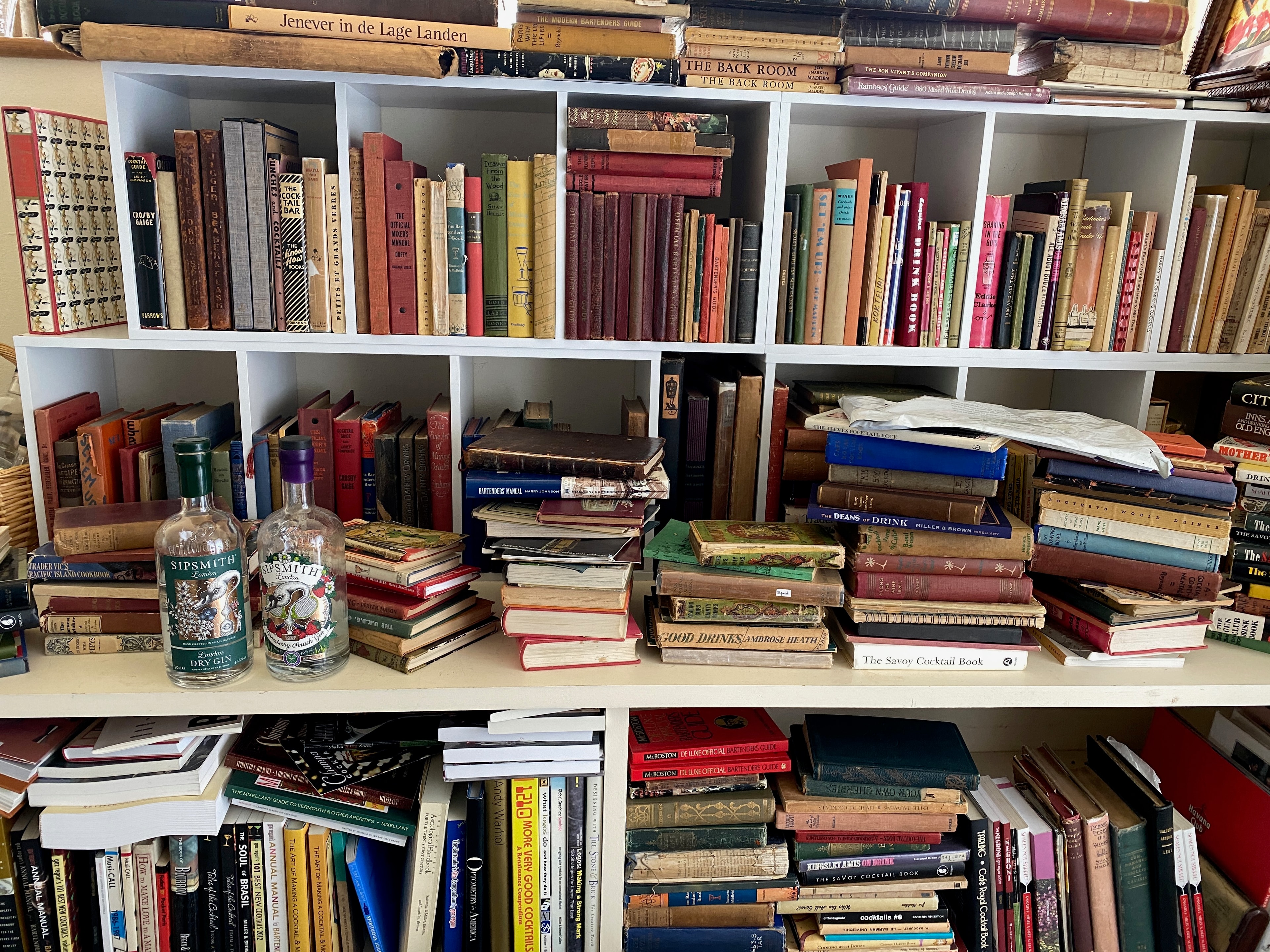
A free working library for the study of drinks history
This is a chronological catalogue of what we have available online in the EUVS Digital Collection. Check back regularly as we add more titles to this very important collection of bartending and distilling knowledge.
Want to read what’s inside a volume? Click the link under each title to enter.
Browse the shelves
Explore these books in chronological order
Nouvelle instruction pour les confitures, les liqueurs et les fruits (1692).
Chef to dukes, cardinals, marquises, and a regent, François Massialot shaped professional cooking well beyond France. His celebrated Nouveau cuisinier royal et bourgeois (1691) grew to three volumes by 1734 and appeared in English as The Court and Country Cook through the mid-1750s. This lesser-known companion, first published anonymously in Paris by Charles de Sercy, turns instead to the still room. Its recipes for liqueurs, eaux-de-vie, esprit de vin, ratafias, distilled botanical waters, and hypocras make it a rich source for bartenders intent on building ingredients of their own.
A simple Stomach Julep (Julepum Stomachicum) in this edition calls for a saffron syrup made with sherry, a rectified spirit of mint, and a non-alcoholic mint distillate — an unlikely trio that hints at what the rest of the book holds. Originally compiled by John Quincy and later revised and improved by William Lewis, it runs to page after page of medicinal simples, waters, syrups, and tinctures. For anyone with mad-scientist aspirations behind the bar, it is less a reference than a catalogue of raw material waiting to be put to work.
Ambrose Cooper's book earns its title, and its own title page makes the case better than any summary. The first part covers the processes of distillation and the instruments used, the whole doctrine of fermentation, the drawing of spirits from malt, raisins, molasses, and sugar, their rectification, and instructions for imitating the colour and flavour of French brandies. The second turns to simple waters distilled from plants and flowers. The third treats compound waters and rich cordials, both those long imported from France and Italy and those by then being made in Great Britain.
The first known volume in English devoted entirely to mixed drinks, Oxford Night Caps: A Collection of Receipts for Making Various Beverages Used in the University appeared in edition after edition between 1827 and 1931, guiding Oxford students through the drinks served at gatherings on and off campus. The softcover format and, largely, the recipes stayed constant throughout. Ice rarely figures here; dilution came from room-temperature water, room temperature in England being a cool thing indeed, and ice only arrived around the turn of the century. Rumfustian, the punches, and the lower-alcohol cups all reward revisiting.
The first known volume in English devoted entirely to mixed drinks, Oxford Night Caps: A Collection of Receipts for Making Various Beverages Used in the University appeared in edition after edition between 1827 and 1931, guiding Oxford students through the drinks served at gatherings on and off campus. The softcover format and, largely, the recipes stayed constant throughout. Ice rarely figures here; dilution came from room-temperature water, room temperature in England being a cool thing indeed, and ice only arrived around the turn of the century. Rumfustian, the punches, and the lower-alcohol cups all reward revisiting.
The first known volume in English devoted entirely to mixed drinks, Oxford Night Caps: A Collection of Receipts for Making Various Beverages Used in the University appeared in edition after edition between 1827 and 1931, guiding Oxford students through the drinks served at gatherings on and off campus. The softcover format and, largely, the recipes stayed constant throughout. Ice rarely figures here; dilution came from room-temperature water, room temperature in England being a cool thing indeed, and ice only arrived around the turn of the century. Rumfustian, the punches, and the lower-alcohol cups all reward revisiting.
Alexis Benoit Soyer's runaway bestseller includes Gold Jelly made with eau-de-vie de Danzig, a Maraschino Jelly studded with quartered fruits, and a Rum-Punch Jelly — an idea Jerry Thomas lifted for the cognac-and-Jamaican-rum Punch Jelly in his 1862 guide, warning that gelatine so artfully concealed the punch's strength that guests were often left unfit for waltzing. London's most famous French chef, Soyer earned £1,000 a year at the Reform Club, fed 26,000 famine victims daily in Dublin, and later opened a 40-drink American-style bar. Jelly shots and blue drinks, a century early.
The Bar-Tender's Guide or How to Mix Drinks (1862)
The first drinks book in English to include cocktail recipes, Jerry "The Professor" Thomas's landmark work — later retitled How to Mix Drinks or the Bon-Vivant's Companion — captured the mixed drinks that had swept the United States by the early 1860s. Ten cocktails appear: Brandy, Champagne, Fancy Brandy, Fancy Gin, Gin, Japanese, Jersey, Soda, The, and Whiskey. Thomas's 1859 stint behind the bar at London's Cremorne Pleasure Gardens brought back British adaptations, including Soyer's Gin Punch and the deceptively strong Punch Jelly. Bottled cocktails and punches for faster service feature too.
Cups and Their Customs (second edition, 1869; first published 1863)
Henry Porter and George Roberts had no warmth for the American bars and "sensation-drinks" arriving in London, and were glad the Pick-Me-Up and Corpse Reviver had made so little headway. British palates, they felt, wanted neither that sweetness nor that tooth-numbing cold. They offer instead gentler drinks built on spice and complexity: wine cups, punches, and older compounds such as wassail, lamb's wool, and metheglin, with ales and beers central to several. As bartenders hunt for lower-alcohol and beer-based ideas, this book becomes a tempting source. —Anistatia Miller This is the second edition which was published in 1869, the first edition appeared in 1863.
Cooling Cups and Dainty Drinks (1869; this is the 1872 edition)
William Terrington's book is the earliest British publication to record cocktail recipes alongside the classic British and European mixed drinks that came before them. Among its curiosities is a Gin Cocktail made with ginger liqueur — very likely the drink a 1798 London newspaper described as "vulgarly called ginger" — and several formulas devised in the 1850s by Britain's first celebrity chef, Alexis Benoit Soyer, which had already appeared in Jerry Thomas's 1862 guide. Popular with a public newly curious about American iced drinks yet still loyal to its own traditions, it was reprinted in 1872 and 1890.
One of many trade titles from Jesse Haney & Co., Publishers, this slim 82-page volume carries an outsized question with it. Collectors such as Mauro Majoub and drinks historians Jared Brown, Anistatia Miller, and Dave Wondrich believe it may be the book Harry "The Dean" Johnson referred to as his very first and earliest work. No one will ever know for certain. What is beyond doubt is its value as a record of American mixing at an early stage: not only the drink recipes, but formulas for fruit wines, cordials, liqueurs, and bitters set down alongside them.
Cups and Their Customs (second edition, 1869; first published 1863)
Henry Porter and George Roberts had no warmth for the American bars and "sensation-drinks" arriving in London, and were glad the Pick-Me-Up and Corpse Reviver had made so little headway. British palates, they felt, wanted neither that sweetness nor that tooth-numbing cold. They offer instead gentler drinks built on spice and complexity: wine cups, punches, and older compounds such as wassail, lamb's wool, and metheglin, with ales and beers central to several. As bartenders hunt for lower-alcohol and beer-based ideas, this book becomes a tempting source. —Anistatia Miller This is the second edition which was published in 1869, the first edition appeared in 1863.
The first known volume in English devoted entirely to mixed drinks, Oxford Night Caps: A Collection of Receipts for Making Various Beverages Used in the University appeared in edition after edition between 1827 and 1931, guiding Oxford students through the drinks served at gatherings on and off campus. The softcover format and, largely, the recipes stayed constant throughout. Ice rarely figures here; dilution came from room-temperature water, room temperature in England being a cool thing indeed, and ice only arrived around the turn of the century. Rumfustian, the punches, and the lower-alcohol cups all reward revisiting.
The first book to set down comprehensively how to open, stock, and run a bar, this remains required reading for novice and professional alike. Prussian-born Harry Johnson first published it in 1882 and revised and expanded it three times as his grasp of the trade deepened, in 1888, 1900, and posthumously in 1934. It carries the first published Martini recipe, along with the Marguerite, ancestor of the Dry Martini. Read straight through, the recipes form a timeline of the American Golden Age of Cocktails: the Morning Glory Fizz and dozens of early vermouth-family drinks among them.